

Lazada
Lazada is a comprehensive e-commerce platform that serves the Asia-pacific market. The e-commerce platform consists of Marketplace, LazMall, and LazGlobal. Lazada has its own e-wallet called Lazada Wallet. Lazada is served by Lazada Logistics and Cai Niao for its logistics solution for endpoint delivery.
Asia E-Commerce Total Addressable Market
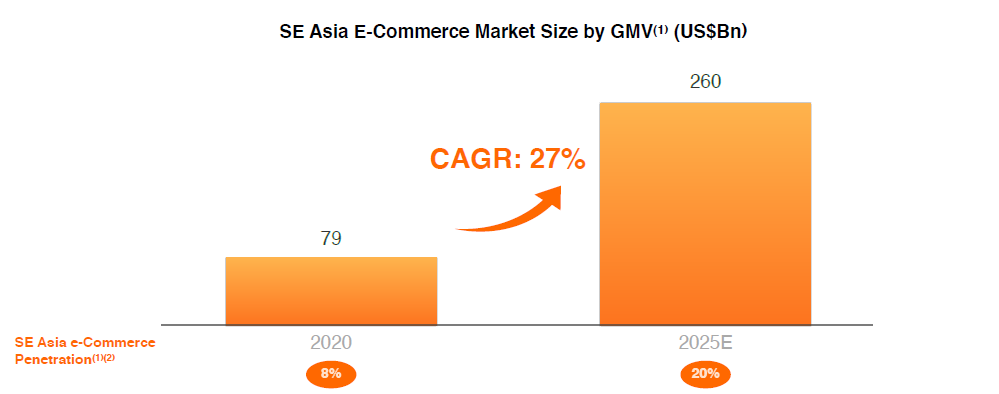
In the above image, based on Frost & Sullivan’s market research, the e-commerce penetration was 8% based on US$79 billion in 2020. It will grow at a CAGR of 27% to US$260 billion in 2025 with a penetration rate of 20%. There is still lots of room for e-commerce penetration to grow. Lazada aims to achieve US$100 billion in terms of GMV and serve more than 300 million consumers.
The AAC has grown from 73 million in March 2020 to 130 million in September 2021. The MAU has grown from 92 million in March 2020 to 159 million in September 2021. The monthly selling sellers have grown by 2.1x from 443,000 in March 2020 to 922,00 in September 2021.
Lazada’s app uses diversified channels for user acquisition through Meta, Instagram, and Tik Tok. It has its own Lazada advertising network and partner with Google. There is acceleration in buyer’s engagement. The AAC increases by 2.6x from March 2019 to September 2021. The DAC increases by 3.7x from March 2019 to September 2021. The Growth in App Order according to Lazada Business Analytics has a 20% growth in conversion rate.
They have designed content and incentives driving higher conversions. Lazlive engages users with live streaming, achieves more than 18 million views on 11th November 2021. The app uses gamification to engage users through campaign games, in-game brand exposure, coins games.
Lazada is building its own logistics network. Lazada wants to provide a superior user experience. It empowers sellers with quality logistics at a competitive cost. It has the ability to optimize parcel flow, leveraging end-to-end data insights. Through end-to-end controlled in-house capabilities, it achieves close to 100% allocation and tracking of parcels. There is a 27% reduction in variable cost per parcel. Lazada Logistics is the 2nd largest B2C logistic network in South East Asia.
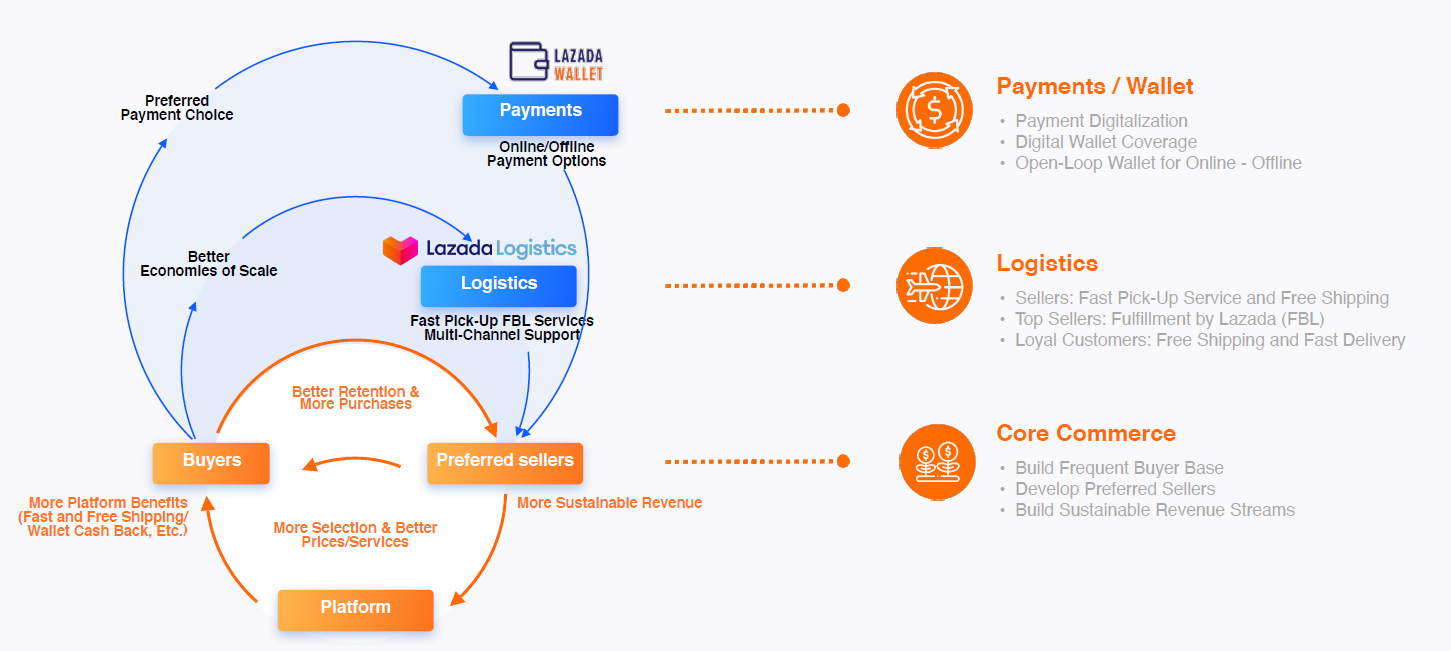
Lazada serves as the preferred e-commerce platform in the Asia Pacific market. The platform aims to provide more benefits such as free shipping and cashback service. This will attract more buyers. More buyers will naturally attract more sellers. They can create economies of scale which drives down prices. Integrated logistics support, reduces the cost of transportation and passes back the benefit to the sellers. Lazada Wallet allows online and offline payment options to buyers. This creates a free float for the business while getting terms from the seller. The flywheel effect is the key competitive advantage for an integrated e-commerce business.
Cainiao Network
Cainiao Network is the smart logistics solution for Alibaba group. It achieves 27% YoY growth for global parcel volume in 2020. It achieves 37% China parcel volume YoY growth till September 2021.
On the consumer logistics segment, Cainiao Post covers around two-thirds of China cities. There is 88% daily package volume YoY growth ended September 2021. On International Logistics Network, there is 40% revenue YoY growth in September 2021. Domestic Smart Supply Chain has more than 20% revenue YoY Growth.
Cloud Technologies
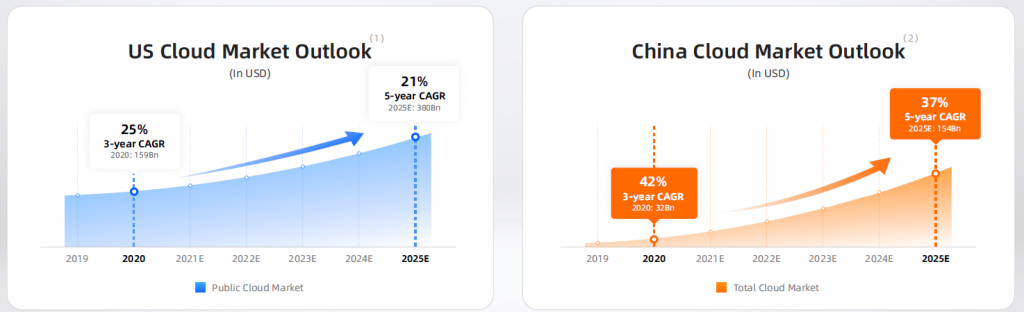
The Cloud industry in China sees a 5-year CAGR of 37% from USD 32 billion to USD 154 billion. There is a huge runway. China National Strategy for digital transformation will continue to invest in digitalization, the Internet of Things, Artificial Intelligence, Cloud-Network Integration, and the industrialization of digital technology.
Alibaba Cloud Revenue is RMB 69.2 billion in April 2021. There are more than 4 million paying customers with 62% being A-share listed companies. They are moving out of China to capture the Southeast Asia market. They achieve 60% revenue growth in September 2021. This is the key growth sector for Alibaba.
Leave a Reply