
updated on 14th October 2024
BHP Group (Listed in ASX under the ticker symbol BHP) operates in Australia, Europe, China, Japan, India, South Korea, Asia Pacific, and North and South America. They operate through Copper, Iron Ore, and Coal segments. It engages in the mining of copper, gold, zinc, silver, iron ore, cobalt, and other metals. The company is involved in the smelting and refining of nickel and potash development. It was founded in 1851 and headquartered in Melbourne, Australia.
Let’s talk about material science 101. Copper has electricity conducting, corrosion resistance, and antimicrobial properties and is used in everyday household products. Iron ore is used for the steel-making process. Nickel is a key ingredient in stainless steel and a major component in the lithium-ion batteries that are helping power the electric vehicle revolution.
BHP is the world’s lowest-cost iron ore producer, delivering record volumes of Western Australia Iron Ore as of FY24. BHP’s global copper assets grew by 9% for the second consecutive year. BHP has built a pipeline of copper projects in Chile and Australia. At Copper SA, BHP has a strategy to deliver up to 650 ktpa of copper. BHP is going to strengthen its copper resource position and in the early stages acquire a 50% interest in the promising Filo del Sol and Josemaria copper projects in Argentina. For BHP’s iron ore portfolio, it is studying further potential expansions at WAIO to increase output up to 330 Mtpa. The construction of the Jansen potash project in Canada is ahead of its original schedule. BHP has suspended temporarily its Nickel operation in Western Australia due to the global oversupply of nickel.
Commodities are demand-driven. China is experiencing recovery, it is depending on its pro-growth strategies to achieve its growth target. The property market is going to remain a drag. India will become the fastest-growing major economy, it is a bright spot for commodities demand. India maintained its growth momentum after the election, especially in terms of its demand link to the steel industry. Developed economies’ growth should recover due to a reduction in interest rates in the following years. The long-term perspective for steel, non-ferrous metals such as copper, and fertilizers remains positive. This is due to population growth, urbanization, rising living standards, and the infrastructure required for decarbonization and electrification.
The commodities sector is all about demand and supply.
Copper Segment
Copper prices rose in H2 FY24, due to expectations of lower interest rates in the US, possible copper smelter cuts in China, and LME banning Russian metal. Copper prices moderated due to near-term fundamentals with weak Chinese demand and surplus stock. In the near term, the demand remains solid due to traditional sectors from home building, to electrical and household appliances. The emerging sectors such as AI and data centers are adding to the demand.
Escondida’s copper production has increased 7% to 1,125 kt from FY23 1,055 kt. Its unit cost is USD 1.45/lb. Pampa Norte’s copper production has decreased by 8% from FY23 289 kt to FY24 266 kt. Its unit cost is USD 2.13/lb. Copper South Australia sees a 39% increase in production to 322 kt in FY24 compared to FY23 232 kt. Its unit cost is US$1.37/lb.
Iron Ore Segment
Iron ore consumption in China was strong in CY23. Steel output continued to contract in developed regions at a slower rate than in previous years. Over the next 2 years, there should be a small improvement in global steel production due to growth led by India and Southeast Asia.
In FY24, Chinese blast furnace run rates will ease in CY24, due to subdued steel margins and policy-driven production controls. H2 FY24, iron ore prices declined and traded around USD 100 – 120/t. There are surplus inventories. There will be a modest decline. BHP forecast bottom support between USD 80 – 100/t. The Chinese property sector’s stabilization and the government’s policy to regulate steel production will determine the iron ore price for the rest of CY 24. BHP forecast that China’s steel production has plateaued above 1.0 Bt and will continue across the mid-2020s.
Western Australia Iron Ore production increased by 1% to 255 Mt in FY24 compared to FY23 253 Mt. Its unit cost is US$18.19/t. Samarco production increased 5% to 4.7 Mt compared to FY23 4.5 Mt.
Geotechnical plots
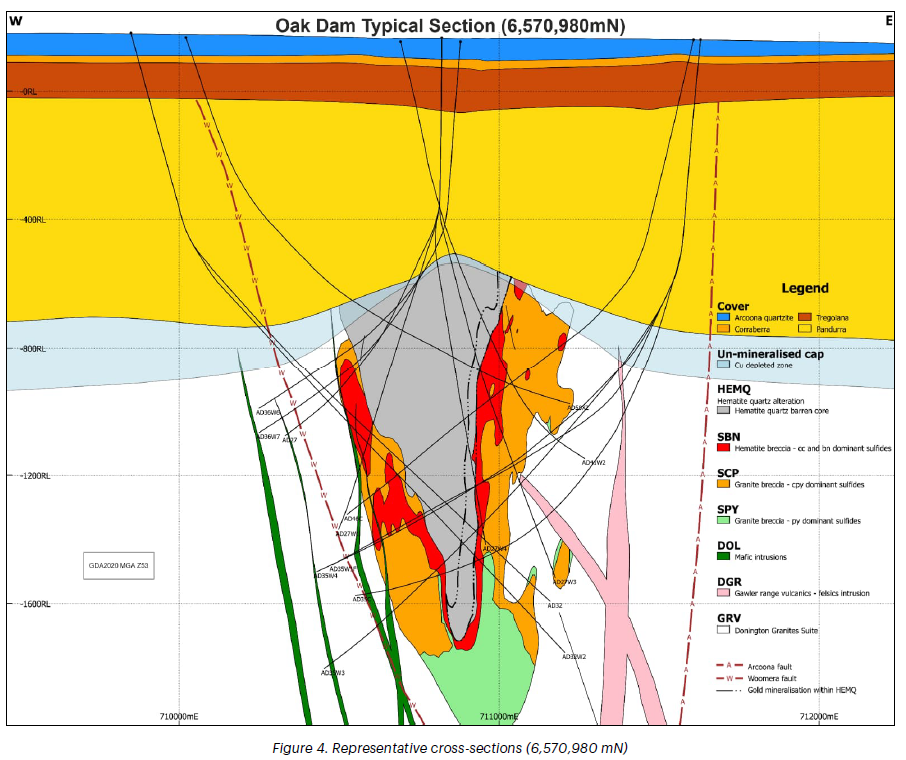
This is the first time I have seen this type of drawing. It is similar to my industry drawing but here they highlight the mineral deposits and the faults, whereas my industry is about gas and oil deposits. They involve onshore drilling whereas my industry is drilling offshore which means in the middle of the sea. It involves exploration permits and how they estimate the total quantities of minerals.
Risk
updated on 19th October 2024
The business is vulnerable to environmental risk. On 18th October, BHP and Vale reached a tentative agreement with the Brazilian government on one of the largest environmental settlements which is around USD 31 billion. Around 43 million tons of toxic mining waste were released into the environment and into nearby local villages when the mine’s Fundao tailings dam collapsed on 5th November 2015. A tailings dam holds the waste generated by mining activities, including toxic materials such as arsenic, lead, and mercury. The sludge contaminated the Doce River and devastated the livelihoods of impacted communities around Mariana in the Brazilian province of Minas Gerais. This cost if shared with Vale will cost BHP around a year of free cash flow.
Financial
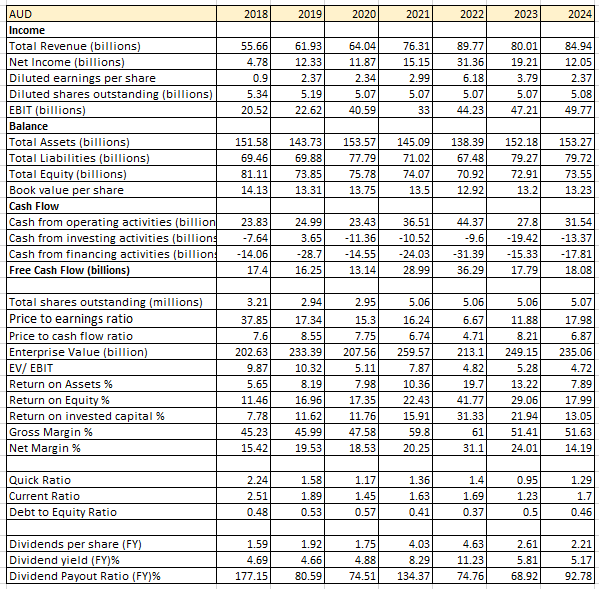
BHP’s ROE has been more than 15% from FY2019 to FY2024.
BHP’s ROIC has been 10% from FY2019 to FY2024.
BHP’s Free Cash Flow has been positive from FY2018 to FY2024. It has been an average of AUD 15 billion.
BHP’s EBIT is upward trend increasing from AUD 20.52 billion in FY2018 to AUD 49.77 billion in FY2024.
Conclusion
BHP Group remains a major player in the global mining and resources sector, with a diversified portfolio and a focus on sustainability. For investors, understanding the dynamics of commodity prices, analyzing financial performance, and keeping abreast of regulatory and economic factors are crucial for making informed investment decisions.
If you are interested in opening an account with Interactive Brokers, you can sign up via my referral link here. Interactive Brokers allows you to trade globally. The products encompass stocks, ETFs, options, futures, forex, bonds, and funds worldwide from a single integrated account.
Leave a Reply